Open specification · CC BY 4.0 · v0.1 draft
TRANSLATE · RETRIEVE · ASSESS · COMPARE · EXPORT
TRACE — material selection when part of the evidence comes from a model.
Ashby's method assumed the data came from one curated database. It now arrives from six places at once, in the same font, to the same number of significant figures. TRACE grades every number by how far it can be defended, and produces a record somebody else can audit.
The problem
Your shortlist mixes six kinds of number and shows you one.
Where numbers come from now
Specification minima from standards. Typical values from mill datasheets. DFT results from open computational databases. Machine-learned predictions. A supplier's application engineer. And, increasingly, a language model that will state a figure to three significant digits without a source.
What the interface tells you
Nothing. They are rendered identically. The one that came from a certified test report and the one the model produced from nothing look the same, sit in the same table, and are equally easy to paste into a design note.
Who carries it
You do. Your name is on the documentation, the tool's is not. The question at the review is never "which model did you use" — it is "where did this number come from", and it is asked six months later.
The method
Ashby, plus the step the data supply chain now requires.
Translate is unchanged. Screening and ranking become Compare. Ashby's fourth step, documentation, becomes Export and acquires a defined structure. Retrieve and Assess are the additions — and they exist because the sources changed, not because the method was wrong.
Translate
Requirements into function, constraints, objectives, free variables. Each constraint is a property, an operator, a value, a unit and the condition it holds at. "Good corrosion resistance" is not a constraint. "PREN ≥ 32, seawater, 40 °C" is.
ASHBY, UNCHANGEDRetrieve
Assemble candidates. Every one carries the name of the source that supplied it — including the ones a model proposed. Every retrieval carries its date, because databases are revised and models are replaced. Candidates you rejected are recorded with the reason.
MADE EXPLICITAssess new
Before you rely on a value, give it an origin and an evidence level, and record the provenance that level requires. A tool may propose a level. A person accepts it. This step does not exist in the classical method because there was nothing to assess — the data came from one place, and that place was the answer.
THE ADDITIONCompare
Screen, then rank — on values that now carry levels. Where candidates are separated by less than the uncertainty of the governing property, the record says they are not separated. A ranking more precise than its inputs is a fabrication performed by arithmetic.
ASHBY: SCREENING + RANKINGExport
A Material Decision Record, not a chat transcript. Self-contained: a reader who never saw the session can reconstruct what was used, where it came from, what was rejected and why, and what you decided. It names the accountable engineer, and it states its own limitations.
ASHBY: DOCUMENTATION, GIVEN A STRUCTUREThe E-ladder
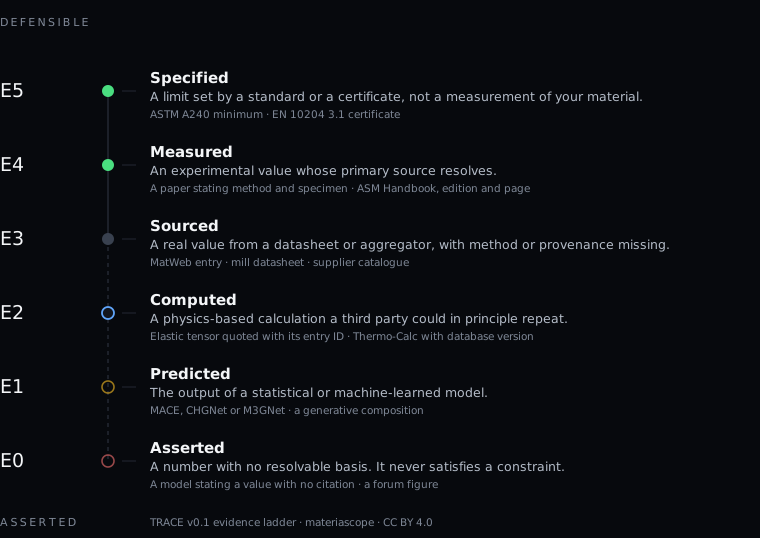
Six levels. Higher is more defensible — not more scientific.
The level is a property of the record of a value, not of the underlying physics. A superb measurement, recorded without its method, is a weakly evidenced value. Computed and predicted numbers sit low because the ladder measures defensibility in design documentation, which is what you are exposed on — not because the science is worse.
| Level | Name | What it is |
|---|---|---|
| E5 | Specified | A specification minimum or a certified test result. What you design to. |
| E4 | Measured | An experiment whose primary source resolves. A measurement, not a limit. |
| E3 | Sourced | A real value from a datasheet, catalogue or aggregator. Material named, method not. Fine for screening. |
| E2 | Computed | DFT, CALPHAD, FEA. Repeatable in principle by a third party. |
| E1 | Predicted | ML, MLIP, surrogate or generative model. A hypothesis with an address. |
| E0 | Asserted | A number with no resolvable basis. Never satisfies a constraint, never ranks a candidate. |
A model is not a level
A language model that states a property value with no citation gives you E0. The same model, handing you a citation you can open, gives you the level of whatever it pointed at. The distinction is not about the technology. It is about whether the thing at the other end of the pointer exists.
The number with two right answers
Duplex 2205, minimum proof strength: 450 MPa to ASTM A240, 500 MPa to EN 10088-2. Same alloy, both correct, 11% apart. Neither means anything without the standard beside it — which is why a source is not decoration.
The rules
Four of the eight do most of the work.
Admissible
E0 never satisfies a constraint. Below E3 is provisional only. Below E5 is a design allowable only if a named engineer records an explicit acceptance, with a reason.
Weakest link
A derived quantity takes the lowest level of its inputs. A specific stiffness from an E5 modulus and an E1 density is E1. Arithmetic does not create evidence.
Dated
Every value carries the date it was retrieved. No date, no level above E3 — because the reader cannot know which revision you read.
Demoted
A claimed level a third party cannot verify from the record alone drops one level. The demotion, its reason and the condition for restoring it are recorded.
The other four: no silent promotion — a tool may not raise a level, and confidence is not provenance. Reproducibility — same query, same sources, same record, or say that you are non-deterministic. Qualitative requirements stay qualitative — weldability does not become a score so that it can be ranked. Origin bounds level — an asserted number is E0 no matter how well it is labelled.
The artefact
The Material Decision Record.
A selection produces a record, not a shortlist. JSON Schema, a markdown template for filling in by hand, and a validator that enforces the rules rather than suggesting them.
$ python3 tools/trace_validate.py examples/heat-exchanger-tubesheet.mdr.json

TRACE v0.1 — MDR-2026-0819-HX-TUBESHEET
--------------------------------------------------------------------
evidence levels
  E5    0
  E4    0
  E3    7  ########################
  E2    0
  E1    0
  E0    1  ####

  highest level in record: E3

conformance: Level 2 — Auditable
Seven E3 values, one E0 that was offered and rejected, nothing above E3 — and the record still conforms at Level 2. That is the intended result. Conformance does not claim the evidence is strong. It claims you can see how strong it is.
| The specification | Five steps, six levels, eight rules, three conformance levels. Short on purpose. |
| The ladder | The ladder on one page. Print it and put it next to the monitor. |
| The audit checklist | Twenty minutes, no vendor cooperation required. |
| The record builder | Build a Material Decision Record in the browser. Nothing is uploaded. |
| The validator | Drop a record in and get the same verdict the command line gives. Works offline. |
The thirty-second test
One test, if you only have time for one.
Ask any tool for a specific property of a specific material. Take the number it gives you. Try to reach the exact source of that exact number in under two minutes.
If you cannot, the value is E0 — whatever the interface looked like — and it does not belong in your documentation.
This is not a test language models fail by construction. A model that hands you a citation you can open passes it. Nor is it a test only AI tools take: run it on a search engine, on a handbook PDF, on a colleague's recollection, on your own internal spreadsheet. E3 is entirely serviceable for screening. The point is to know which level you are standing on when you sign.
Conflict of interest
We sell a product in this space, so we published our own score first.
- Retrieval date is not shown, which caps every value we produce at E3 under the date rule — including values that would otherwise be clean E2
- Rejected candidates are not recorded, so our output shows conclusions rather than analysis
- Output is non-deterministic and the interface does not say so
- Trade designations — 316L, S355, Inconel 718 — bridge incompletely to composition-indexed databases. This is the gap that matters most to an engineer
- Polymers, elastomers, composites and anything formulated are outside our data layer, so under this framework we should not answer questions about them at all
Why publish that
A public score we have to keep updating is harder to quietly abandon than an internal backlog. And it is obviously also marketing — a vendor publishing its own failures reads as credible, and we know that.
The defence against it being merely a posture is structural: the checklist is vendor-neutral, the licence lets competitors run it against us and ship a product that scores better, and the failures above are specific enough to check.
If you run the audit on Materiascope and get a better result than we published, that is a bug in our document and we would like to hear about it.
What it does not do
The limits, stated before you find them.
- It does not make a decision correct. A record can conform fully and describe a bad choice. It makes a decision auditable, and it keeps responsibility where it already sits — with you
- It does not override a qualified materials list. Where ECSS, ASME III, MMPDS or an internal approved-materials specification governs, that governs
- It does not assess metrological traceability in the ISO/IEC 17025 sense, and does not claim to
- It is not finished. Five open questions are published in the specification, two of which the maintainer suspects are wrong: whether E2 sits too low, and whether Level 3 is reachable at all for a tool built on live third-party databases
- It has no worked example containing real E2 or E1 values, because we would not publish a fabricated entry ID in a repository about not fabricating things. That is the most wanted contribution