AI for materials engineering

Select, join and invent materials with AI

An engineer's workspace, not a chatbot with opinions. Every answer names the database it came from.

No card · 20 AI requests a month on the free plan

118Elements
37Materials
7Crystal systems
14Bravais lattices
3Open databases
The knowledge base

Strength against density, for every material in the library

The chart engineers actually reason with — built from the same data behind every material page. Each bar is one material's published range; click one to open it.

Strength against density for 25 engineering materials A logarithmic property chart. Density runs from 0.8 to 12 grams per cubic centimetre on the horizontal axis and strength from 10 to 3000 megapascals on the vertical axis. Each material is drawn as a vertical capsule spanning its published strength range, coloured by material class. σ/ρ = 30 σ/ρ = 300 1 1.5 2 3 5 8 10 10 30 100 300 1000 3000 Density ρ (g/cm³) Strength σ (MPa) AISI 1045 carbon steel — ρ 7.85 g/cm³, tensile strength 565–850 MPa AISI 4140 (42CrMo4) — ρ 7.85 g/cm³, tensile strength 900–1200 MPa AISI 304 / 1.4301 stainless — ρ 7.9 g/cm³, tensile strength 515–720 MPa AISI 316L / 1.4404 stainless — ρ 8 g/cm³, tensile strength 485–620 MPa 17-4PH (1.4542) — ρ 7.75 g/cm³, tensile strength 930–1310 MPa Ductile iron EN-GJS-400-15 — ρ 7.1 g/cm³, tensile strength 400 MPa Aluminum 6061-T6 — ρ 2.7 g/cm³, tensile strength 310 MPa Aluminum 7075-T6 — ρ 2.81 g/cm³, tensile strength 572 MPa Ti-6Al-4V (Grade 5) — ρ 4.43 g/cm³, yield strength 830–1100 MPa Magnesium AZ31B — ρ 1.77 g/cm³, yield strength 150–220 MPa Copper Cu-ETP (C11000) — ρ 8.94 g/cm³, yield strength 70–330 MPa Cartridge brass C26000 (CuZn30) — ρ 8.53 g/cm³, tensile strength 300–900 MPa Bearing bronze C93200 (SAE 660) — ρ 8.9 g/cm³, tensile strength 240 MPa Monel 400 (NiCu30Fe) — ρ 8.8 g/cm³, yield strength 240–480 MPa Inconel 718 — ρ 8.19 g/cm³, yield strength 1030 MPa Hastelloy C-276 — ρ 8.89 g/cm³, yield strength 355 MPa Alumina Al₂O₃ (99.5 %) — ρ 3.9 g/cm³, compressive strength 2500 MPa Zirconia Y-TZP (3Y) — ρ 6.05 g/cm³, flexural strength 900–1200 MPa Silicon nitride Si₃N₄ — ρ 3.2 g/cm³, flexural strength 700–1000 MPa Polyamide PA66 (nylon) — ρ 1.14 g/cm³, tensile strength 80 MPa Polycarbonate (PC) — ρ 1.2 g/cm³, tensile strength 65 MPa PEEK — ρ 1.3 g/cm³, tensile strength 100 MPa PTFE (Teflon) — ρ 2.2 g/cm³, tensile strength 25 MPa CFRP (carbon/epoxy laminate) — ρ 1.55 g/cm³, tensile strength (0°) 1200–2000 MPa GFRP (glass/epoxy or polyester) — ρ 1.9 g/cm³, tensile strength 300–1100 MPa CFRP · best strength-to-weight Alumina Al₂O₃ · strongest Polyamide PA66 · lightest
Metals & Alloys (16) Ceramics & Glasses (3) Polymers & Elastomers (4) Composites (2) 25 of 37 library materials publish both a density and a strength. Bars span the published range; the dot is its midpoint.
Crystallography

Structure decides behaviour

Packing sets the number of slip systems, and slip systems set whether a metal forms or fractures. 7 systems, 14 Bravais lattices, each with its own page.

FCC — ductile
BCC — strong
HCP — anisotropic
BCT — martensite
How it works

Three steps from requirement to shortlist

01

State the problem

“Seawater impeller, 60 °C, cavitation, field-weldable, under €40/kg.”

02

Get ranked candidates

Property ranges, why each fits, where it hurts, how it is joined.

03

Verify, then commit

Check against the structure databases, export, take it to your own testing.

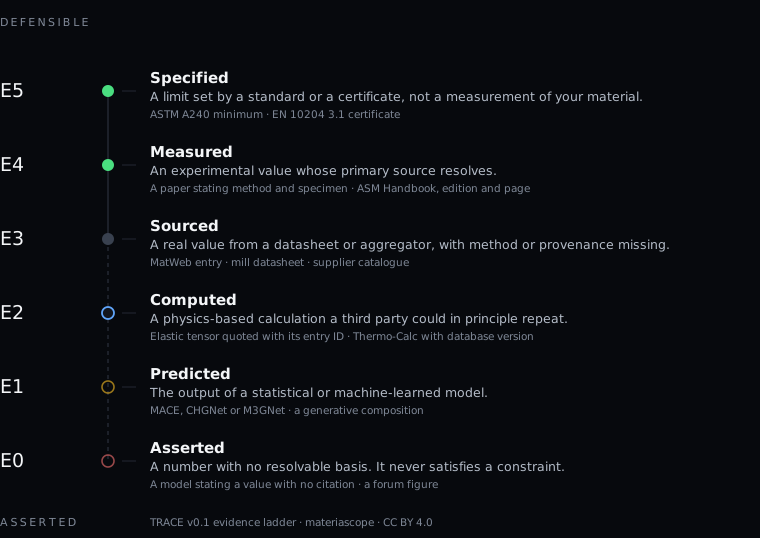
Cites its sources

Database, DOI or “general knowledge — verify”. Never a bare number.

Open data, live

Materials Project, OQMD, OMDB, OpenAlex, arXiv, PubChem.

Ranges, not false precision

SI units with the condition attached, the way datasheets read.

Hypotheses labelled as such

Generated materials come with the experiment that would falsify them.

Pricing

Start free. Upgrade when it saves you time.

Free

$0 / month
  • 20 AI requests / month
  • Materials chat, selector and creator
  • Projects and report generator
  • Full public knowledge base
  • Community support
Start free

Pro

$29 / month
  • 500 AI requests / month
  • Saved results, history and exports
  • Priority models
  • Email support
Go Pro

Team

$99 / month
  • 5 seats
  • 2,500 AI requests / month, shared
  • Shared material library
  • Everything in Pro
  • Priority support
Start Team

Full comparison on the pricing page.

FAQ

Questions engineers ask first

What does materiascope actually do?

It is a workspace for materials engineers: an AI chat tuned for materials science, a selector that turns application requirements into a ranked shortlist of candidate materials, a creator that proposes novel compositions with a synthesis route, projects and a report generator that keep the work together, and a knowledge base of elements, alloys and crystallography. The AI modules can query open materials databases mid-answer and cite which one a number came from.

Is the knowledge base free?

Yes. The periodic table, materials library, material classes and crystallography reference on this site are public and need no account. Only the AI modules require signing in.

Where does the data come from?

Reference data on this site is curated from standard engineering sources and published property ranges. Live structure search queries the OPTIMADE API across the Materials Project, OQMD and the Open Materials Database. The AI modules additionally consult OpenAlex, arXiv and PubChem, and name the source in the answer.

Can I trust the AI output for a real design?

Treat it as a starting point, not a certificate. Property values are typical ranges, not lot-specific data, and generated material concepts are hypotheses. Every result must be validated against standards, datasheets and your own testing before it reaches a design.

Do you train models on my data?

No. Your prompts and results are used to serve your session and your saved history, not to train models.

Can I cancel at any time?

Yes. Plans are monthly and cancel at the end of the current billing period. The Free tier stays available afterwards.

Put an engineer's AI on the problem

Free plan, no card required. 20 AI requests a month, and the whole knowledge base stays open to everyone.