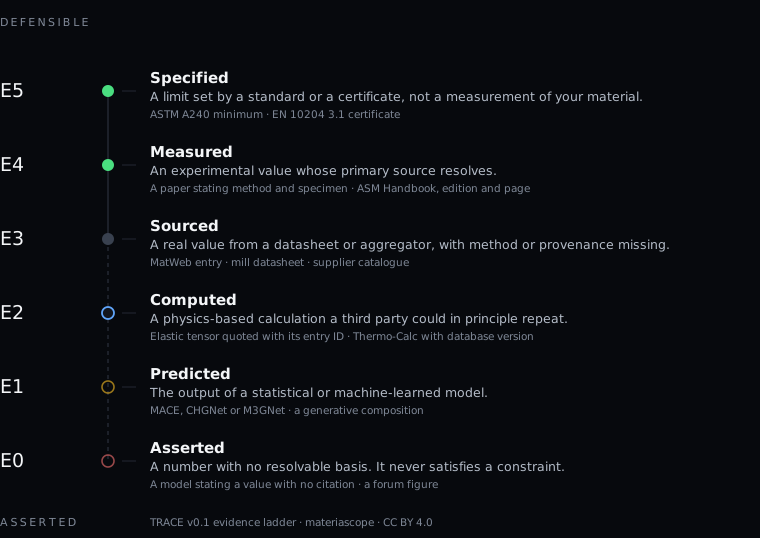
Part of TRACE, an open framework for material selection. CC BY 4.0. Last verified 19 August 2026.
Why a value needs a grade at all
Thirty years ago the question about a property value was whether you had read the right row. The data came from one curated database, somebody had checked it, and the failure mode was human error in the lookup.
A shortlist assembled today mixes specification minima from standards, typical values from mill datasheets, DFT results from open computational databases, machine-learned predictions, and numbers a language model produced without a source. They render identically. They sit in the same table. They are equally easy to paste into a design note.
The engineer signs the drawing. The tool does not. So the engineer needs to know which is which, before the review and not during it.
E5 — Specified or certified
A limit set by a standard or a certificate, not a measurement of your material.
The record must contain: the standard designation with its edition, the clause or table, the product form, and the condition — or a certificate identifier for the actual heat.
Examples: a minimum proof strength from ASTM A240; an MMPDS A- or B-basis allowable; a value from a mill test certificate under EN 10204 3.1.
This is the only level admissible as a design allowable without an explicit, recorded acceptance by a named engineer. It is also the level most often claimed and least often supported: quoting “ASTM A240” without an edition, a table and a product form is a claim about a document nobody has opened.
E4 — Measured and traceable
An experimental value whose primary source resolves.
The record must contain: a resolvable primary source — a DOI, a handbook edition and page, a test report — plus the test method, the specimen condition, and the temperature or environment.
Examples: a creep curve from a peer-reviewed paper that states the specimen geometry and the test standard; an ASM Handbook value with the edition and page cited.
E4 is a measurement, not a limit. That difference is the subject of a separate page, because it is the mistake with the most expensive consequences: see specified minimum versus typical value.
E3 — Sourced but thinly traceable
A real value — measured, or computed by the source — from a supplier datasheet, a catalogue or a property aggregator, where the material is named but the method, the sample condition or the provenance chain is not.
The record must contain: a resolvable source, the material designation, and a retrieval date.
Examples: a MatWeb entry; a Total Materia record; a mill datasheet giving typical physical properties; a supplier catalogue.
This is where most of what a search engine returns for a property query lands, and it is entirely serviceable for screening. It is not sufficient as a design allowable. Most engineering work happens at E3 and there is nothing wrong with that — the point is knowing it.
E2 — Computed and transparent
A physics-based calculation a third party could in principle repeat.
The record must contain: the method and the code; the functional, database or model parameters; a resolvable entry identifier where the calculation comes from a database; and the retrieval date.
Examples: an elastic tensor from an open computational database, quoted with its entry ID; a Thermo-Calc run with the database version stated; an FEA result with the mesh and boundary conditions recorded.
The same number quoted without the entry ID is not E2. It is E0 wearing a lab coat.
E1 — Predicted
The output of a statistical or machine-learned model.
The record must contain: the model name and version; the training set or its citation; the quantity predicted; and the reported uncertainty — or an explicit statement that the model provides none.
Examples: an MLIP prediction from MACE, CHGNet or M3GNet; a surrogate model output; a composition proposed by a generative model.
A hypothesis with an address. There is nothing dishonourable about E1 — a great deal of current materials research runs on it. It is not a design allowable.
E0 — Asserted
A number with no resolvable basis.
Examples: a language model stating a property value without a citation; a figure from a forum; a value copied between spreadsheets until nobody remembers where it entered.
E0 values must not be used to satisfy a constraint or to rank a candidate. They may appear in a record only as rejected inputs — and recording them is worth doing, because a record showing what was discarded is more useful than one pretending it never appeared.
A model is not a level
The most common misreading of this ladder is that it ranks AI last. It does not rank AI at all.
A language model that states a property value with no citation gives you E0. The same model, handing you a citation you can open, gives you the level of whatever it pointed at — which may be E5. The distinction is not about the technology. It is about whether the thing at the other end of the pointer exists.
That is also the whole of the thirty-second test in the tool audit: take a number, try to reach its exact source in under two minutes, and grade what you find.
The four rules
Admissible. E0 never satisfies a constraint. Below E3 is provisional only. Below E5 is a design allowable only when a named engineer records an explicit acceptance, with a reason.
Weakest link. A derived quantity takes the lowest level of its inputs. A specific stiffness computed from an E5 modulus and an E1 density is an E1 quantity. Arithmetic does not create evidence.
Dated. Every value carries the date it was retrieved. No retrieval date, no level above E3 — because the reader cannot know which revision of the database, the standard or the datasheet was consulted.
Demoted. A claimed level that a third party cannot verify from the record alone drops one level. The demotion, its reason and the condition for restoring it are recorded. Demotion is normal and is not a defect.
The number with two right answers
Duplex stainless 2205, minimum proof strength:
| Value | Standard | Level |
|---|---|---|
| 450 MPa (65 ksi) | ASTM A240/A240M | E5 |
| 500 MPa | EN 10088-2 | E5 |
Same alloy. Both correct. Eleven per cent apart.
Neither number is better than the other, and neither means anything without the standard beside it. An engineer who carries “2205 yields at 450” from one project to another, and lands on a drawing governed by EN, is not wrong about the alloy — they are wrong about which document they are working under, which is a harder error to see and a more expensive one to find.
This is why a source is not decoration. It is part of the value.
Where things usually land
| Where the number came from | Typical level |
|---|---|
| ASTM, EN or ISO specification minimum, edition cited | E5 |
| MMPDS A- or B-basis allowable | E5 |
| Mill test certificate for the actual heat | E5 |
| Peer-reviewed paper with method and conditions | E4 |
| ASM Handbook, edition and page cited | E4 |
| Mill datasheet, typical values | E3 |
| MatWeb, Total Materia, supplier catalogue | E3 |
| Materials Project or OQMD entry, with its ID | E2 |
| Thermo-Calc or JMatPro run, database version stated | E2 |
| MLIP or surrogate prediction | E1 |
| A language model stating a value with no citation | E0 |
| A language model resolving a citation you can check | the level of the source it resolved to |
What this page does not cover
- Whether the number is correct. The ladder measures how far a value can be defended, not whether it is true. Standards contain errors and certificates are occasionally wrong. A specification minimum for the wrong product form is worse than a good measurement.
- Uncertainty. TRACE v0.1 requires that reported uncertainty be recorded, but does not specify how it propagates. Propagating uncertainty and propagating evidence level are different operations and only the second is defined.
- Formulated materials. Polymers, elastomers, composites, concretes, coatings and adhesives are defined by formulation and process history, not composition alone. The provenance fields assume an identity that formulations do not have. This is an acknowledged gap.
- Metrological traceability in the ISO/IEC 17025 sense. Related idea, different subject.
- Qualified materials lists. Where ECSS, ASME III, MMPDS or an internal approved-materials specification governs, it governs. TRACE documents how you reached a candidate; it does not override a qualification.
Use it
The full specification, the record schema and a validator are open source under CC BY 4.0 and MIT: github.com/materiascope/trace.
Run the tool audit against whatever you use today — including us. Our own score is published at /trace/self-assessment and currently reads does not conform at Level 1.